A lab report with AI: aim, table, error and conclusion
Pick a subject, a grade and a topic – a lab report form appears on the right. The AI explains the experiment, helps set up the measurement table, calculates the error from your numbers and checks your conclusion.
Aim
Learn to determine the density of a solid using a balance and a measuring cylinder.
Equipment
Balance with weights, measuring cylinder with water, a solid body on a thread.
Procedure
- Measure the mass m of the body on the balance.
- Measure the volume of the body with the cylinder: V = V₂ − V₁.
- Calculate the density and compare it with the density table.
Measurement table
| m, g | V, cm³ | ρ, g/cm³ | ρ, kg/m³ |
|---|---|---|---|
Calculation
ρ = m / V; 1 g/cm³ = 1000 kg/m³
Conclusion
The density of the body ρ = … kg/m³. From the density table, it is closest to …
Prompt sent to the chat: «Help me understand the lab work on physics «Determining the density of a substance» (grade 7). Explain the aim and the procedure step by step: what we do and why, what equipment is needed and what to watch for. Do not write the conclusion for me – at the end, ask me 3 questions so I can check myself.»
You can attach a photo of the task or the notebook page. Free on the Starter plan (30 units of energy).
How to format a lab report: six parts
The order is almost the same in physics, chemistry and biology. If your teacher gave a sample, follow it – the AI will adapt.
- 01
Aim
What you need to find out or learn to do. Starts with a verb: "determine", "measure", "study".
- 02
Equipment
Instruments and materials as a list. For measuring instruments, it helps to note the division value right away.
- 03
Procedure
The steps of the experiment in order, briefly and the way you actually did them.
- 04
Table
A column for each quantity, units in the header rather than in the cells.
- 05
Calculation
The formula, the numbers substituted, the result with units and error.
- 06
Conclusion
The answer to the aim: what you got, which number, whether it matched what you expected.
How to write the conclusion of a lab report
The conclusion mirrors the aim. Reread the aim of the lab and answer it in your own words, adding the result of your measurements.
Determine the density of a solid using a balance and a measuring cylinder.
I determined the density of the body: ρ = … kg/m³. From the density table, it is closest to … I explain the difference by …
Determine the acceleration of a ball rolling down a track.
The acceleration of the ball a = … m/s². Across the trials it hardly changed, so the motion was uniformly accelerated.
Examine the structure of onion skin cells under a microscope.
In the onion skin cells I saw … The cells are shaped like … and fit tightly against each other.
Ellipses mark the places for your numbers and observations. Write the conclusion yourself and paste it into the form at the "Check my conclusion" step: the AI will point out what is missing.
Measurement error, in plain terms
First the division value: the difference between two neighbouring labelled marks is divided by the number of divisions between them. The instrument error is often taken as half the division value.
Lab reports in physics, chemistry and biology: sample topics
Click a topic – it goes into the form at the top, together with the subject and the grade. Lab titles differ between textbooks, so type your own topic if needed.
Physics
Chemistry
Biology
Photograph your notebook – we will work from your notes
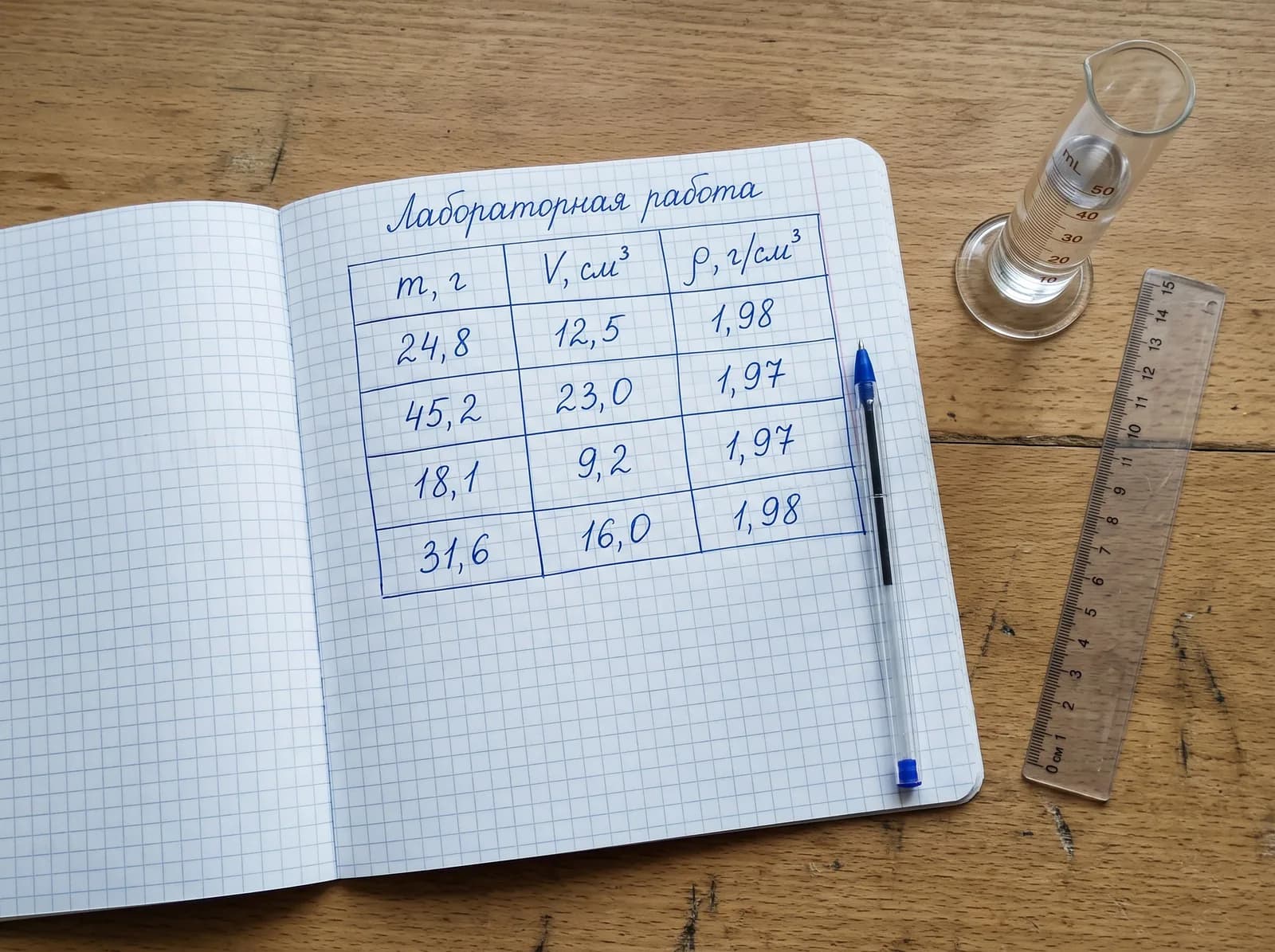
The chat accepts photos on the free plan too. Send the task page, a table with your numbers or a draft conclusion – the AI reads the picture and carries on from where you stopped.
It works best like this: first ask why each step of the experiment is needed; after the lab, send your measurements for the calculation; and at the end, your conclusion for a check.
Lab report help – for free
Starter – 0 ₽
30 units of energy. An explanation of the procedure, a table, an error calculation and a conclusion check are text requests; they are included in the free plan, and photos are too. If you study every day, there is Lite at ₽690 (150 units of energy) and Base at ₽990 (200 units of energy).
FAQ
Will the AI help with a physics lab report?
Yes: it explains the aim and the procedure, suggests which columns the table needs, calculates from your measurements and checks the conclusion. The experiment and the measurements are yours – the AI helps you understand them and write them up.
How do I write the aim of a lab report?
In one sentence with a verb: "determine the density of a substance", "measure the volume of a body", "study the structure of a cell". The aim is usually already in the task – it is enough to rephrase or clarify it.
How do I write the conclusion of a lab report?
Answer the aim: what you determined or saw, which number you got, with units and an error, and whether it matched what you expected. Paste your conclusion at step 4 – the AI will check it against the aim.
How do I calculate a measurement error?
Find the division value of the instrument; the instrument error is often taken as half of it. If you repeated the experiment, calculate the mean and the deviations. Ask your teacher which rule to use: requirements differ between grades.
Can I send a photo of my notebook or the task?
Yes, the chat accepts photos on the free Starter plan too. Photograph the task page or the table with your numbers – the AI reads the picture and answers from it.
Are there answers to lab reports by their textbook numbers?
No: the answers depend on your measurements, and they differ between classes. Send the text or a photo of the task – the AI explains the procedure and helps calculate from your data.