Individual project: from topic to defence in five steps
Pick a subject and a topic – the AI mentor will help you formulate the relevance, goal and tasks of the project, build the structure and rehearse the defence. The research and the text are yours; the hints and the checks come from the AI.
Three topics for the subject – pick one, and it goes into the “Project topic” field
Object: knowledge of plant growth and the role of light. Practice: an experiment with three groups of plants under different light. Product: an observation table and a care guide.
The preview is built from ready-made samples: support and hints, while the research and the text are yours.
Your own topic? Type it in – the request sent to the chat changes, and the preview stays an example.
Prompt sent to the chat: «Help me choose a topic for an individual project in the subject “Biology”. I am in grade 10. I am currently thinking about the topic “How light affects the growth of houseplants”. Suggest 2 more topics with a practical part I can do on my own, and for each, what product it would give. I will make the choice: ask me clarifying questions about my interests.»
Each step is a separate request in one chat. Free on the Starter plan (30 units of energy).
Open the step in chatTopics for an individual project: 10 ideas by subject
A good topic is one with a practical part of your own: an experiment, a survey, an item or a website. Click an idea – it opens in the wizard at the “Topic” step.
Project goal and tasks: how not to mix them up
The most common mistake in the introduction is a goal written as a task, or tasks that repeat the goal in other words.
One goal
- Answers the question “why?”
- Tied to a result or a product
- Checked at the end: reached or not
Study plants.
Find out how light affects the growth of houseplants, and make a care guide.
3–5 steps
- Answer the question “what do I do?”
- Start with a verb: study, analyse, carry out, draw a conclusion
- Follow the order of the work
Learn a lot of new things about plants.
Carry out an experiment with three groups of plants under different light.
Types of individual projects
The type decides what you show at the defence. The AI will help you see which type your idea belongs to.
Research
A hypothesis, an experiment or a survey, and conclusions from the data.
Product: tables, graphs, conclusionsPractice-oriented
Solves a specific problem for a class, a school or a family.
Product: an item, a bot, a reminderInformational
Collects and organises information on a topic.
Product: a handbook, a dictionary, a leafletCreative
The result is an original work with a rationale for the idea.
Product: a collection, an exhibition, a routeDefending the project: what the committee will ask
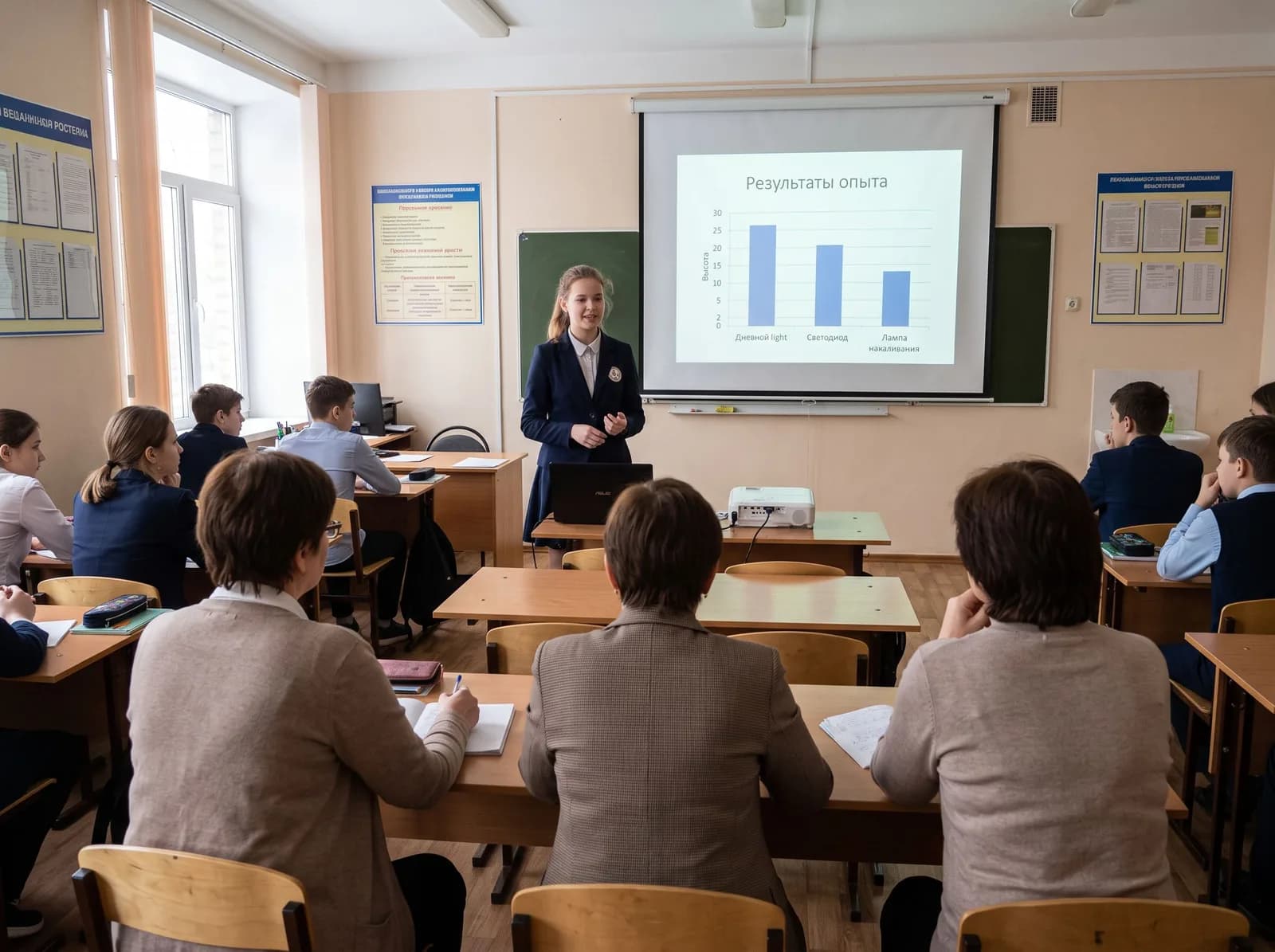
The talk lasts 5–7 minutes: topic and relevance, goal and tasks, course of work, result, conclusion. Then come the questions. The most common ones are:
- Why did you choose this topic?
- What was the most difficult part?
- How did you check your sources?
- Was the goal reached, and how can you tell?
- Where can your product be used?
At step 5 the AI asks these questions about your topic and assesses your answers – like a rehearsal before the committee.
The individual project mentor is free
Starter – 0 ₽
30 units of energy. Choosing a topic, relevance, goal and tasks, structure and rehearsing the defence are text requests, and they are included in the free plan. If the project takes several weeks, there is Lite for ₽690 (150 energy) and Basic for ₽990 (200 energy).
FAQ
Which topics should I choose for an individual project in grade 10?
Choose a topic that has your own practical part and a clear product. Pick a subject at the “Topic” step – the AI will suggest options that fit your interests and ask questions so that you make the choice yourself.
How do I word the goal and tasks of a project?
The goal is one and answers the question “why”; the tasks are 3–5 steps that start with verbs. At step 3 the AI will show an example for your topic, check your wording and explain what to fix.
What goes into the introduction of an individual project?
The relevance, the goal, the tasks, the object and the subject, the methods. The AI will ask questions about each point and help you turn your answers into a coherent text – but you write the text yourself.
Is there a sample structure for an individual project?
Yes, at step 4: introduction, theory chapter, practical part, conclusion, list of sources and appendices. Formatting requirements differ between schools – check them against your school’s guidelines.
How do I prepare for the project defence in grade 9?
Step 5 gives you a plan for a 5–7 minute talk and five likely questions from the committee. Answer them in the chat – the AI will assess your answers and suggest what to strengthen.
Can the AI do the project for me?
This helper works differently: it guides you through the steps and checks your work, while the experiment, the survey and the text are yours. That makes it easier to answer the committee’s questions with confidence.